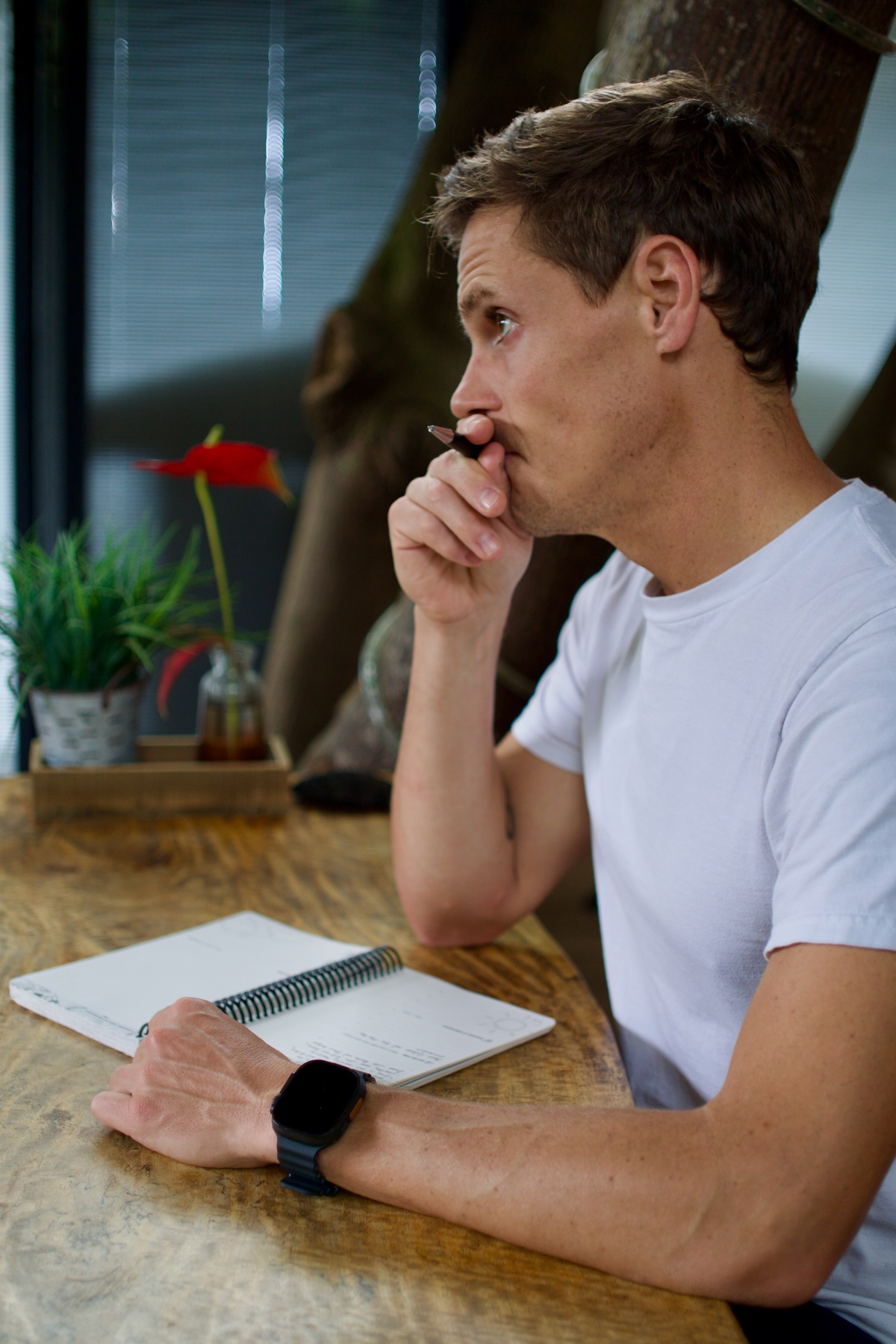
When I’m caught up in worry and overthinking, I come back to state, story, strategy: how I’m feeling, what I’m telling myself, and what I’m actually going to do.
I was recently working with a client who was concerned about a big decision in his life. He was hyperfixating on the problem, repeating a familiar story, and trying to intellectualize himself into a strategy that could solve it.
In my own life, as well as my coaching, I come back to a state-story-strategy approach. This practice has truly saved my life, and it’s a cornerstone of how I work with clients.
What is state-story-strategy?
State: How are you feeling in your body? Tired, fearful, tense? Happy, free, abundant? Start with a positive state change. A few intentional breaths or some movement can be a place to begin.
Story: What does the voice in your head say? Do you believe in yourself, or are you reinforcing a story that you’re going to fail? Recognize what you’re telling yourself. There’s power in shifting that story.
Strategy: What are you actually going to do? We normally put this first, trying to figure out the how before attending to the first two. When my state and story are in a better place, the next move often comes much more naturally.
This is how we start our sessions. For clients new to mindfulness, we tailor a brief practice they can use on their own.
With this client, we took some deep, intentional breaths. His shoulders dropped. He loosened up, smiled more, and even let out some big yawns. It was as if his body finally gave him permission to relax.
Then we reminded ourselves of what we’re grateful for: our lives, healthy bodies, food in our kitchens, and our families.
I encourage my clients to feel gratitude in their heart. To smile and give themselves a moment to feel it in their entire body. It’s completely free, and I’m continually reminded of how powerful it can be.
For me, it’s hard to stay hyper-focused in fear when I’m really feeling grateful.
Why does last month’s worry feel different?
“Do you remember what you were so worried about a month ago?”
I asked my client this question. I had my notes, so I remembered. We’d spent months working through a different challenge that had caused him stress and distrust in himself.
Now he could talk about it freely. It didn’t have the same weight.
Three months ago? He literally couldn’t remember.
We tend to hyperfixate on the problems of the day. Sometimes we supersize them as if they’re life and death. The stressful feeling stays familiar while the actual events come and go.
There was a time when the only thing I cared about was surviving my illness. Another when I was consumed with selling my house and moving to Hawaii. Then there’s the next client, a difficult conversation, or facing rejection.
It seems like there’s always something to worry about.
Those things mattered. But looking back, I don’t feel them the way I did then. It’s empowering to remember that while facing whatever comes next.
What’s one next step you can take?
Oftentimes, there are one or two uncomfortable things, like a difficult conversation, a public expression, or one task, that unlock so much of our stress around these bigger problems.
Lean into that.
Take a breath. Feel something you’re grateful for. Then ask yourself: what’s the uncomfortable thing I know I need to do?
If you’d like to learn more about how I work and explore working with me, explore private coaching.
Further reading
What Golf Revealed About My Coaching Work: More from my work with pressure, self-doubt, and the patterns we carry into daily life.
Meditation and Mindfulness: Effectiveness and Safety: An overview from the National Institutes of Health for readers who want to explore the research.